



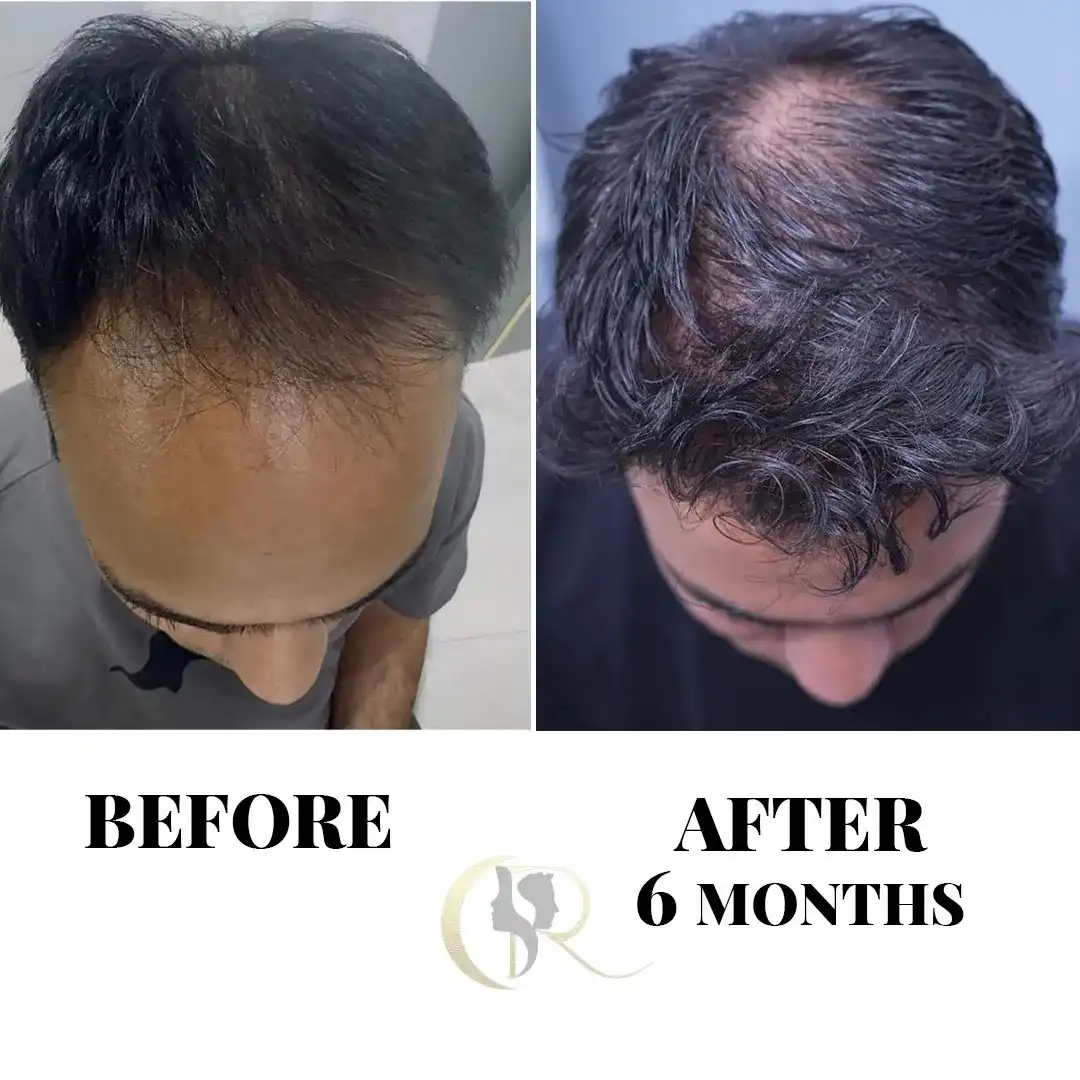
The Norwood-Hamilton Scale: Quantifying Male Pattern Baldness
When men begin researching hair transplants, the most frequent question is: "How many grafts do I need for my head?" In clinical trichology, surgical planning begins with the Norwood-Hamilton classification system, which categorizes androgenetic alopecia into seven distinct stages.
Graft Requirement Breakdown by Norwood Stage
- Norwood Stage 2 (Mature Hairline): Mild recession around temple corners. Typically requires 1,000 to 1,500 grafts for temple reconstruction.
- Norwood Stage 3 (Early Frontal Baldness): Deep symmetrical triangular recession past the coronal plane. Requires 1,800 to 2,200 grafts.
- Norwood Stage 3-Vertex: Frontal recession accompanied by early thinning at the crown whorl. Requires 2,200 to 2,800 grafts.
- Norwood Stage 4 (Mid-Scalp Thinning): Frontal bridge remains thin; prominent crown bald patch. Requires 2,800 to 3,500 grafts.
- Norwood Stage 5 (Merging Front & Crown): Band separating front and crown breaks down. Requires 3,500 to 4,200 grafts (often staged in 2 sessions).
- Norwood Stage 6 & 7 (Extensive Baldness): Single continuous bald area with horseshoe donor rim. Requires 4,500+ grafts, often combining beard and scalp donor resources.
The Golden Rule: Single-Session Safety Limits
Commercial clinics frequently advertise "mega-sessions" of 5,000+ grafts in one day. From a plastic surgery safety perspective, harvesting over 3,500 grafts in a single sitting compromises scalp vascularity, elevates graft transection rates, and leaves unsightly donor thinning. Staged procedures preserve natural tissue healing.
Use our real-time Interactive Hair Graft Calculator to preview your customized plan.
Hair Graft & Surgical Candidacy Evaluator
Calculate estimated follicular unit requirements and evaluate your suitability based on validated Norwood-Hamilton clinical parameters.
Current Selection: Norwood 3: Deep Frontal Recession — Frontal recession creating pronounced M-shape pattern; requires hairline redesign.
Age helps assess stability of native donor hair and future miniaturization velocity.
Determines whether medical stabilization is recommended prior to surgery.
Safe extraction limits depend on donor follicular unit density and hair caliber.
Favorable Surgical Candidacy
Stable hair loss pattern with healthy donor density. FUE or DHI sapphire direct implantation is suitable for dense, natural restoration.
Want an exact hairline design and donor microscopic assessment?
Get an in-person clinical consultation and trichoscopy analysis with Dr. Prem Sunder & trichology team.
*Medical Disclaimer: Follicular unit calculations and candidacy indicators are educational projections based on standardized clinical averages. Individual scalp elasticity, hair caliber, and miniaturization dynamics require formal microscopic trichoscopy and physician evaluation. In compliance with National Medical Commission (NMC) regulations, results may vary by individual physiological response.
Have questions about this procedure?
Speak directly with our senior surgeons and medical team at Cosmo Radiance Hyderabad for confidential clinical guidance.